
Customer Service

What Are the Top Animal Healthcare Syringe Types in 2026?

Animal healthcare depends on accurate dosing, calm handling, and equipment suited to each animal. In 2026, the Animal Healthcare Syringe market includes several practical types, from standard disposable syringes to oral dosing devices and specialized insulin syringes. Each serves a different purpose. A syringe used to measure a small dose for a cat may not suit a larger animal or a thicker medication.

This guide introduces common options and the details that matter during selection. Disposable syringes are widely used for single-use applications, while reusable models require careful cleaning and handling according to their design. Oral syringes deliver liquid medication without a needle. Insulin syringes use fine graduations for small-volume measurements, and multi-dose models can support repeated dosing when compatible with the product and care routine. Small differences matter. Barrel markings, tip fit, material, and dose capacity can affect day-to-day use.

There is no universal best choice. Species, medication, administration route, and the prescribed volume all influence what is appropriate. A clear scale can help reduce measurement errors, but it cannot replace trained handling or veterinary guidance. Product names can also be confusing, so check the manufacturer’s specifications rather than relying on labels alone. This overview compares the main syringe types and explains where each may fit. It also leaves room for a useful question: are familiar products always the best fit for a changing practice? That deserves a closer look.
What Are the Top Animal Healthcare Syringe Types in 2026?

How Veterinary Syringes Work and What Sets Them Apart

A veterinary syringe turns a measured volume into a controlled injection. The plunger draws fluid through the needle, while barrel markings help the clinician measure a dose. Common choices include fixed-needle syringes for small, precise doses; detachable-needle models for flexibility; and larger-capacity syringes for livestock or fluid delivery. Insulin syringes use finer graduations, while oral dosing syringes have no needle and deliver medicine by mouth. The right type depends on the animal, route, fluid thickness, and prescribed volume. Fit matters.

Need gauge and length also matter. A thin needle may reduce tissue trauma, but viscous medication can be harder to push through it. ISO 7886-1:2017 sets performance requirements for single-use manual hypodermic syringes, including leakage and graduated-volume checks; it is a device standard, not a substitute for veterinary judgment. The 2020 AAHA/AAFP Feline Vaccination Guidelines estimate injection-site sarcoma incidence at roughly 1 to 10 cases per 10,000 vaccinated cats, underscoring why route and site deserve careful attention. A syringe cannot correct poor technique. Clinicians should follow product instructions and select equipment suited to the animal and dose. In practice, the smallest practical syringe can make tiny doses easier to read, though that detail is easy to overlook.

Common Syringe Types Used in Animal Healthcare

Common Syringe Types Used in Animal Healthcare

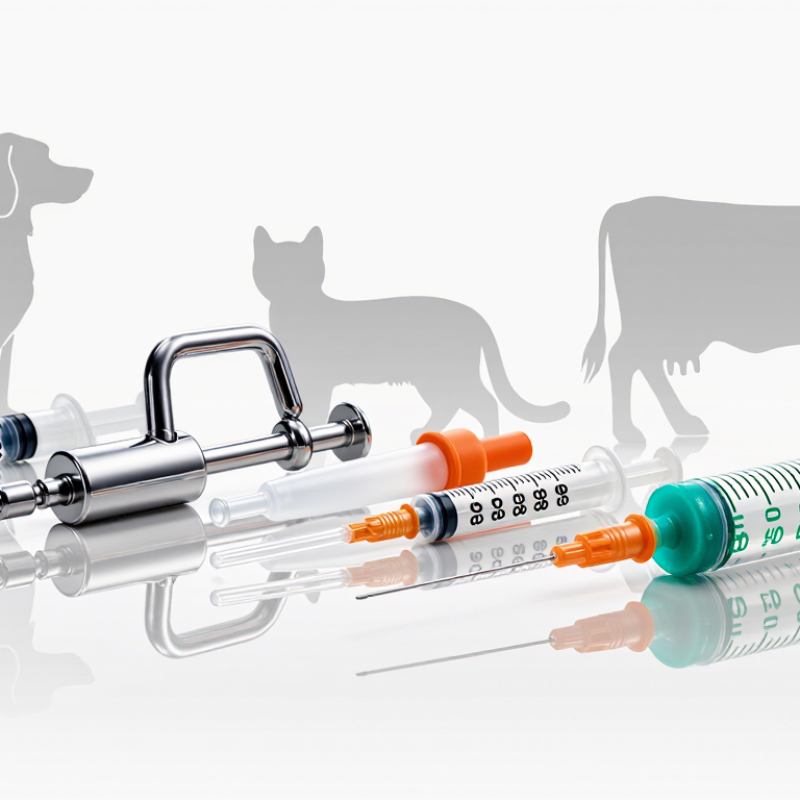
Veterinary teams use different syringes for injections, oral medicines, and animal sizes. Standard disposable syringes, usually plastic, suit many routine injections. Luer-lock fittings help secure needles during handling; slip-tip versions allow quick attachment. Small-volume or insulin syringes offer finer graduations for precise dosing, but the correct scale must match the prescription. Oral dosing syringes have no needle and help deliver liquid medicine to the side of an animal’s mouth. In livestock settings, multi-dose syringes can support repeated vaccination work. Fit matters. Reusable glass syringes are less common in many settings because they require careful cleaning and sterilization.

The Grand View Research 2024 U.S. veterinary healthcare market report estimated the market at USD 22.15 billion in 2023 and projected 7.4% annual growth from 2024 to 2030. This broad market estimate does not measure syringe use, but it reflects expanding veterinary care needs. Syringe choice still depends on the species, route, volume, medicine, and clinician’s instructions. A tiny graduation can be hard to read in a dim treatment room; that detail deserves attention.

Tips: Check the syringe’s units and capacity before drawing medicine. Use a new sterile syringe when indicated, and follow veterinary guidance for needle choice and disposal. Not always. The smallest syringe is not automatically the safest choice.

How Syringe Types Match Different Species and Treatments

Species and treatment—not body size alone—should guide syringe choice. A 1 mL tuberculin syringe helps measure small volumes, while an oral dosing syringe delivers liquid medicine without a needle. For injections, clinicians select syringe capacity and needle length for the prescribed dose, route, and tissue. Small volumes matter. A large barrel can make tiny doses harder to measure accurately, especially in kittens or small mammals. The AVMA’s 2024 Pet Ownership and Demographics Sourcebook estimates 59.8 million U.S. households own dogs, underscoring the range of patients clinics may serve.

For routine injections, 1–3 mL syringes suit many individual doses; a locking connection can help prevent the needle loosening during handling. Insulin syringes are calibrated for insulin, so they should not be substituted for general medication syringes. In livestock settings, calibrated multi-dose syringes can speed repeated treatments, but staff still need to check the dose and device between animals. AAHA’s 2022 Canine Vaccination Guidelines note that vaccine route depends on the specific product. One syringe does not fit every case. Species matters, but so do the drug label, route, and the animal’s condition. A neat size chart can be useful, yet it can also oversimplify: the veterinarian’s dose and technique should decide the final setup.

What Are the Top Animal Healthcare Syringe Types in 2026?

Common syringe capacities and how they may match species and treatment routes

These are representative nominal syringe capacities, not usage or market-share figures. Small-volume syringes are suited to accurately measuring small prescribed amounts; larger-volume and catheter-tip syringes are commonly used for oral, enteral, or irrigation purposes in larger animals. Choose the syringe, route, and needle according to the prescribed treatment and the animal’s species and size.

Key Factors for Choosing a Veterinary Syringe

What Are the Top Animal Healthcare Syringe Types in 2026?

Key Factors for Choosing a Veterinary Syringe

A veterinary syringe should match the animal, prescribed dose, and administration route—not simply what is available. For tiny doses, a low-capacity syringe with fine, clear graduations can make measurement easier. Check that its markings are readable under the clinic’s usual lighting. Fit matters. A large barrel may feel awkward when dosing a kitten, while a small one may require repeated draws for larger volumes.

Choose the tip and needle according to veterinary instructions and the intended route. Luer-lock connections can help secure compatible needles; slip tips attach quickly, but their fit still needs checking. Oral dosing syringes should be needle-free and easy to control. For thicker liquids, confirm that the opening allows smooth flow without forcing the plunger. Don’t guess. Consider whether a syringe is single-use or designed for approved cleaning and reuse, since residue can affect hygiene and measurement.

Materials, grip, and readability matter during actual handling. A textured plunger and clear barrel markings can help when gloves are wet or an animal moves. Check packaging, scale accuracy, and compatibility with the prescribed product. Follow clinic procedures and product instructions; don’t choose a needle or syringe scale by appearance alone. The fit may not be perfect. Reconsider it if the dose is hard to measure, the plunger sticks, or the animal becomes distressed, and ask the veterinary team to confirm a suitable option.

Safe Handling, Cleaning, and Disposal of Animal Healthcare Syringes

Animal healthcare syringes may be disposable or designed for repeated use, and their care differs. Before handling one, check the barrel, plunger, and needle for cracks, residue, or looseness. Wear gloves when blood or medication may be present, and have a trained handler calmly restrain the animal. A sudden turn can cause a needlestick. Work on a clean, well-lit surface, keeping sterile parts away from counters and fur. Small details matter.

Never reuse a syringe labeled for single use. For reusable equipment, follow the manufacturer’s cleaning and sterilization instructions; rinsing alone may not remove medication or microbes. A rushed rinse feels clean. It may not be. Disassemble the syringe only as instructed, and clean it promptly so residue does not dry inside. Inspect it before storage, and discard damaged parts.

Place used needles and other sharps directly into a puncture-resistant sharps container, not loose on a tray or in ordinary waste. Keep the container closed and away from children and animals. Disposal guidance varies by location, so check current instructions with a veterinary clinic or waste service. Even experienced teams can miss a step when busy; a clear written routine helps.

Translate »