
Top 10 SMC Slice Material Press Manufacturers Worldwide?
The global demand for lightweight, corrosion-resistant components is reshaping composite manufacturing. The International Energy Agency reported nearly 14 million electric car sales in 2023, representing about 18% of global car sales. This shift increases interest in structural plastics, including sheet molding compound (SMC). It also raises the need for reliable compression equipment.
This guide examines the Top 10 Smc Slice Material Press Manufacturers Worldwide. The phrase “Smc Slice Material Press” is used here for presses designed to shape pre-cut SMC charges into consistent components. These systems typically combine controlled heating, high closing force, programmable pressure, and repeatable cycle timing. Small details matter. A stable mold temperature can influence surface quality, fiber distribution, and scrap rates.
Market forecasts support this direction, although their figures vary. MarketsandMarkets has projected strong growth for the broader composites market through 2028. Grand View Research also identifies automotive, electrical, and construction applications as major demand areas. These reports are useful, but they do not measure every SMC press manufacturer consistently. That limitation matters.
Our comparison considers press capacity, platen accuracy, automation, energy management, after-sales service, and experience with SMC production. We also examine practical factors, such as loading access, mold-change time, safety controls, and support for multi-cavity tooling. Manufacturer claims require careful checking. A polished brochure is not factory evidence. Buyers should verify cycle data, maintenance records, and customer references before investing. The final ranking is therefore informative, not absolute. Regional service quality can change the result.
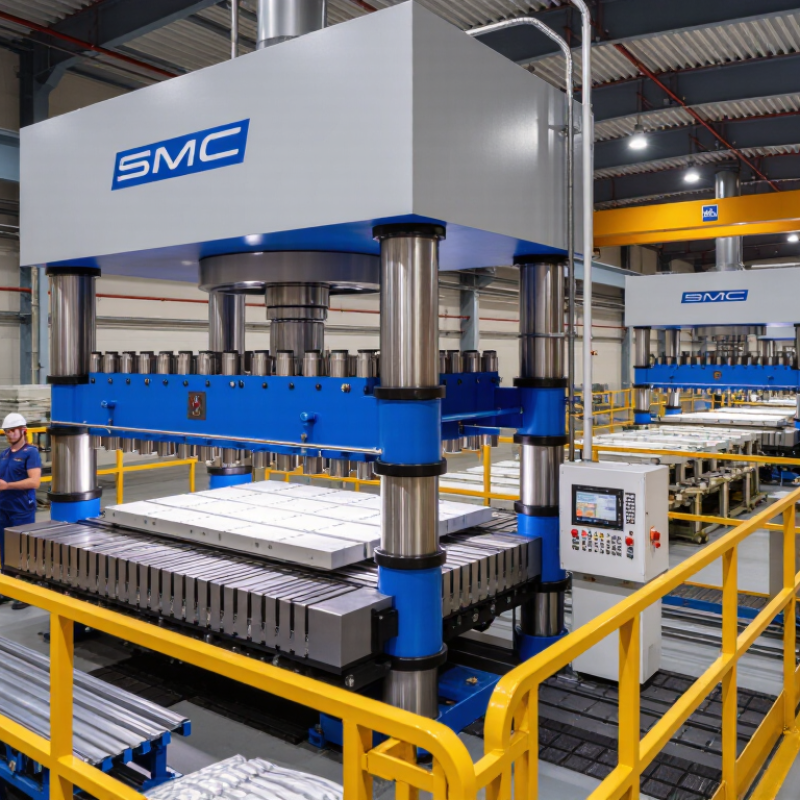
Table of Contents [Hide]
What Is an SMC Slice Material Press?
An SMC slice material press is a hydraulic compression-molding machine for sheet molding compound. It converts measured SMC charges into rigid composite parts. The charge usually contains thermoset resin, chopped glass fibers, fillers, and additives. Operators place it between heated mold halves. Pressure then spreads the material across the cavity.
The term “slice material press” is not perfectly standardized. Some suppliers mean an SMC cutting and charging system. Others mean the complete compression press. That difference matters when comparing manufacturers. A practical system should control platen parallelism, closing speed, molding temperature, and pressure stability. Typical production temperatures range from 140°C to 170°C, depending on the resin formulation. Press capacity may range from several hundred to several thousand tonnes.
MarketsandMarkets estimated the global SMC market at about USD 3.1 billion in 2023, with continued growth through 2028. Its research identifies transportation, electrical equipment, and construction as important application sectors. A separate Lucintel industry analysis also reports strong demand for lightweight composite components in vehicles. These figures support careful investment, but they should not replace plant trials. Material flow can change with fiber length, storage time, mold geometry, and humidity. Even a well-specified press may produce inconsistent edges if charging patterns are poorly designed. Manufacturers should therefore compare recorded cycle data, mold trials, maintenance response, and energy use rather than relying on headline tonnage alone.
Top 10 SMC Slice Material Press Manufacturers Worldwide? - What Is an SMC Slice Material Press?
| Rank | Anonymous Manufacturer Profile | Primary Manufacturing Region | Typical Press Force Range | Typical Platen Size Range | SMC Processing Capability | Common Automation Features | Typical End-Use Applications |
|---|---|---|---|---|---|---|---|
| 1 | Large-scale hydraulic press specialist | Western Europe | 1,000–5,000 metric tons | 1,500 × 1,500 mm to 3,000 × 3,000 mm | Compression molding of large SMC panels, structural parts, and automotive components | Automatic loading, mold shuttle, robotic unloading, recipe control, and process data logging | Automotive body panels, battery covers, industrial housings, and infrastructure components |
| 2 | High-speed composite molding equipment builder | East Asia | 500–3,000 metric tons | 1,000 × 1,000 mm to 2,500 × 2,500 mm | Short-cycle SMC compression molding with programmable pressure and temperature profiles | Servo-hydraulic control, automatic charge placement, mold temperature monitoring, and cycle alarms | Electrical enclosures, automotive interior parts, covers, and appliance components |
| 3 | Custom engineered composite press manufacturer | North America | 600–4,000 metric tons | 1,200 × 1,200 mm to 3,000 × 2,000 mm | Custom compression presses for thermoset composites, including SMC and BMC materials | Multi-zone mold heating, programmable dwell control, safety interlocks, and production monitoring | Transportation, electrical distribution, construction, and industrial equipment |
| 4 | Medium- and large-tonnage hydraulic press producer | Central Europe | 400–2,500 metric tons | 900 × 900 mm to 2,200 × 2,200 mm | SMC molding for medium-sized parts requiring consistent pressure and parallel platen movement | Four-column guidance, digital pressure control, automatic mold opening, and thermal monitoring | Electrical cabinets, vehicle components, pump housings, and machine covers |
| 5 | Cost-efficient industrial press integrator | South Asia | 250–2,000 metric tons | 800 × 800 mm to 2,000 × 2,000 mm | General-purpose SMC compression molding with configurable heating and ejection systems | PLC control, hydraulic proportional valves, automatic ejectors, and operator safety guarding | Electrical accessories, sanitary products, automotive parts, and general molded components |
| 6 | Precision press and automation manufacturer | Japan | 300–2,000 metric tons | 700 × 700 mm to 1,800 × 1,800 mm | Precision molding of SMC parts with emphasis on repeatability, dimensional stability, and low scrap | Servo-driven controls, closed-loop pressure regulation, automated charge handling, and traceability software | Automotive electrical parts, precision covers, mobility components, and electronic housings |
| 7 | Modular composite press system supplier | Southern Europe | 300–1,500 metric tons | 800 × 800 mm to 1,800 × 1,500 mm | Modular SMC compression molding cells for small and medium production volumes | Interchangeable tooling, mold carts, automatic demolding, recipe storage, and remote diagnostics | Lighting housings, electrical components, transportation interiors, and consumer products |
| 8 | Heavy-duty press manufacturer for industrial composites | Greater China | 500–3,500 metric tons | 1,000 × 1,000 mm to 2,800 × 2,500 mm | Large-part SMC compression molding with high daylight and customized mold-space dimensions | Automatic mold exchange, hydraulic synchronization, centralized lubrication, and production counters | Utility boxes, transportation structures, renewable-energy components, and industrial panels |
| 9 | Turnkey thermoset molding-cell provider | South Korea | 400–2,500 metric tons | 900 × 900 mm to 2,200 × 2,000 mm | Integrated SMC molding cells combining the press, material handling, mold heating, and trimming processes | Robotic part handling, vision inspection, automatic trimming interface, and manufacturing execution connectivity | Automotive exterior parts, battery-related components, electrical equipment, and appliance parts |
| 10 | Special-purpose press engineering company | Southeast Asia | 200–1,200 metric tons | 600 × 600 mm to 1,600 × 1,400 mm | Compact SMC presses for pilot production, replacement parts, and medium-volume manufacturing | Manual or semi-automatic loading, programmable heating, digital pressure display, and basic data recording | Electrical fittings, small vehicle components, industrial covers, and molded panels |
An SMC slice material press is a hydraulic compression-molding machine used to heat and press pre-cut Sheet Molding Compound charges between matched molds. The ranges shown are representative industry specifications for anonymous manufacturer categories; actual capacity, platen dimensions, automation, and cycle time depend on the mold, part geometry, material formulation, and production requirements.