How to Choose Deep Well 96 Well Plates in 2026?
Choosing the right deep well 96 well plates in 2026 requires more than comparing prices. Laboratory teams must match plate design with sample type, workflow, and equipment. A plate that performs well for bacterial culture may fail during solvent handling or protein extraction. Small details matter. Well shape, bottom geometry, and working volume can change recovery, mixing, and evaporation.
This guide examines the practical factors experienced laboratory users should review before ordering. It considers polypropylene quality, chemical compatibility, sealing options, and centrifuge resistance. It also discusses automation, because robotic systems need consistent dimensions and reliable plate stiffness. For example, a plate may fit a liquid handler but still cause errors if its wells flex under pressure. Clear labeling areas and barcode compatibility support better sample traceability. These features are easy to overlook.
There is no perfect plate for every application. Manufacturer specifications can also be incomplete or difficult to compare. That uncertainty deserves attention. Users should request technical data, test representative samples, and confirm performance under real operating conditions. A short validation run may reveal leakage, uneven evaporation, or poor pipette access. It is not always convenient.
The best choice balances capacity, data quality, workflow speed, and total cost. This includes waste, failed runs, and storage requirements. Reliable purchasing decisions should involve laboratory staff, equipment specialists, and quality personnel. By evaluating evidence rather than marketing claims, teams can select deep well 96 well plates with greater confidence and fewer surprises in daily work.
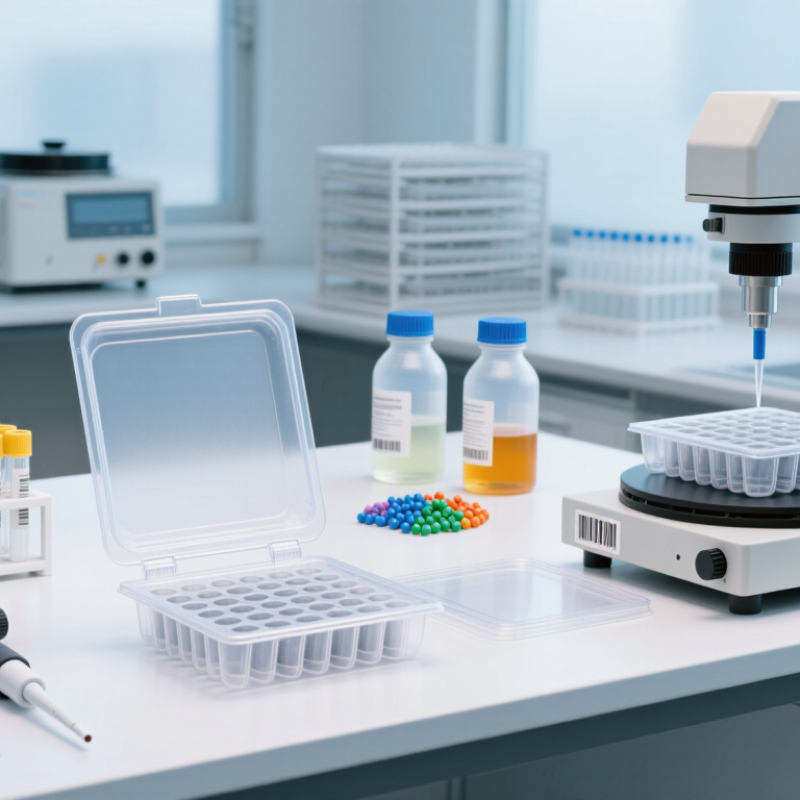
Table of Contents
[Hide]
What Are Deep Well 96 Well Plates?
Deep well 96 well plates are laboratory plates with 96 individual wells arranged in eight rows and twelve columns. Each well is deeper and holds more liquid than a standard microplate well. Depending on the design, working volumes often range from about 0.5 to 2.2 milliliters per well.
They are commonly used for sample preparation, compound storage, cell processing, dilution series, and extraction workflows. Many are made from polypropylene because it tolerates common solvents, low temperatures, and repeated handling. However, chemical resistance varies. Do not assume every polypropylene plate performs identically.
The plate’s bottom shape also matters. V-shaped wells help collect small volumes, while U-shaped wells support gentler mixing and easier liquid recovery. Flat-bottom wells can improve visual inspection. A compatible sealing film reduces evaporation, contamination, and sample loss during storage or shaking.
In automated workflows, dimensional accuracy is critical. Robotic tips must reach the liquid without touching the walls or bottom. Small differences in plate height can cause transfer errors. That detail is easy to overlook.
Centrifuge use requires special attention. The plate, rotor, adapters, and maximum speed must be checked together. A plate may appear sturdy but still deform under unsuitable conditions. I would also verify dead volume, evaporation behavior, and barcode readability before selecting a format. No plate is perfect for every method.
How to Choose Deep Well 96 Well Plates in 2026? – What Are Deep Well 96 Well Plates?
| Selection Dimension | Typical Specification or Fact | How It Helps You Choose |
|---|---|---|
| What They Are | A 96-position microplate with wells substantially deeper than those in a standard assay plate. The wells are designed to hold larger liquid volumes for sample preparation, storage, extraction, and automation. | Choose a deep well plate when a standard 96-well plate does not provide enough working volume or when samples must be mixed, processed, or stored in a multiwell format. |
| Well Count and Layout | 96 wells arranged in 8 rows by 12 columns, usually following the standard microplate footprint of approximately 127.8 mm × 85.5 mm. | The standard footprint supports compatibility with many liquid handlers, plate shakers, centrifuge adapters, storage systems, and robotic workstations. Always verify the equipment manufacturer’s dimensional tolerances. |
| Common Working Volume | Common working volumes range from about 0.5 mL to 2.0 mL per well, depending on well depth, geometry, and the required headspace. | Select a well capacity that is comfortably larger than the intended working volume. Leaving headspace reduces splashing, cross-contamination, and overflow during shaking or transport. |
| Maximum Well Capacity | Typical total capacities are approximately 0.8 mL, 1.2 mL, 1.6 mL, 2.0 mL, or higher per well. The stated capacity is not the recommended operating volume. | Compare both total capacity and recommended working volume. A larger nominal capacity may be unsuitable if it prevents effective mixing or exceeds the available centrifuge and automation clearance. |
| Plate Material | Polypropylene is the most common material because it offers good chemical resistance, low liquid retention, and suitability for many biological and sample-preparation workflows. | Choose polypropylene for general sample storage, nucleic-acid workflows, protein work, and many solvent-containing applications. Confirm compatibility for strong solvents, oxidizers, and aggressive chemicals. |
| Chemical Compatibility | Polypropylene is generally compatible with aqueous buffers, many alcohols, and a range of laboratory reagents, but compatibility depends on concentration, temperature, exposure time, and stress. | Review a chemical-resistance chart and validate critical applications. Do not assume compatibility with every solvent, especially when using concentrated acids, strong oxidizers, or chlorinated and aromatic solvents. |
| Well Bottom Shape |
U-bottom
V-bottom
Flat-bottom
U-bottom wells support mixing; V-bottom wells help concentrate liquid; flat-bottom wells can provide a stable surface for some optical or manual procedures. |
Choose U-bottom for general mixing and sample recovery, V-bottom for collection and maximum liquid retrieval, and flat-bottom designs when visual inspection or a stable bottom surface is important. |
| Well Profile | Deep wells may be round, square, or rectangular in cross-section. Geometry affects mixing behavior, residual volume, evaporation, and pipette access. | Match the well profile to the application and pipette format. Square or rectangular wells often provide efficient packing and liquid-handler access, while rounded wells may simplify mixing and sample recovery. |
| Sealing Options | Available sealing methods include adhesive films, heat seals, pierceable films, silicone or elastomer mats, and snap-on lids. Sealing performance varies with plate rim design and liquid type. | Use a vapor-resistant seal for storage and volatile samples, a pierceable seal for automated pipetting, and a mat or lid when repeated access is needed. Confirm compatibility with shaking, centrifugation, and temperature cycling. |
| Evaporation Control | Evaporation is typically greater at perimeter wells, particularly during long incubations, low-volume work, elevated temperatures, or poorly controlled humidity. | Use an appropriate seal, controlled humidity, shorter processing times, or a perimeter-well strategy. For sensitive assays, assess evaporation experimentally across the entire plate. |
| Centrifugation | Some deep well plates are designed for centrifugation, but allowable force depends on the plate design, material, seal, rotor, adapters, temperature, and fill level. | Never select a plate based only on appearance. Check the stated maximum relative centrifugal force and use the correct plate carrier or adapter. Inspect plates for deformation or damage after spinning. |
| Temperature Range | Polypropylene plates are commonly used across refrigerated, ambient, and frozen conditions. Actual limits vary by plate construction, seal, storage duration, and thermal cycling. | For freezing, verify low-temperature performance, seal integrity, and resistance to cracking. For heating, confirm the maximum temperature and whether the plate remains dimensionally stable in the equipment. |
| Automation Compatibility | Important features include ANSI/SLAS footprint, consistent plate height, flatness, well-to-well uniformity, barcode area, robotic access, and compatibility with the selected pipette tips. | Test the exact plate and seal combination on the intended liquid handler. Well depth, rim height, nesting behavior, and pipette clearance can affect aspiration accuracy and collision risk. |
| Sample Recovery | Residual volume depends on bottom geometry, liquid properties, pipette position, aspiration speed, and the presence of particulates or viscous materials. | For valuable samples, prioritize low-residual-volume designs and validate recovery with the actual liquid. A slower aspiration rate and optimized pipette height can improve recovery. |
| Mixing Performance | Mixing is influenced by well geometry, fill volume, shaking orbit, speed, seal type, and liquid viscosity. Deep wells generally require more careful optimization than shallow assay wells. | Choose a plate that fits the available shaker and validate mixing uniformity. Avoid excessive speed or fill levels that cause splashing, aerosols, or seal leakage. |
| Sterility and Cleanliness | Plates may be supplied sterile or non-sterile, and may be manufactured with different cleanliness specifications. Sterility does not automatically mean low endotoxin or nucleic-acid-free. | Specify the required cleanliness level separately: sterile, non-pyrogenic, low-endotoxin, DNase/RNase-free, or suitable for molecular biology. Select the specification required by the workflow. |
| Optical Requirements | Most deep well plates are intended for sample handling rather than direct optical measurement. Material color, opacity, bottom shape, and wall thickness can limit absorbance or fluorescence readings. | Use a dedicated optical plate for plate-reader measurements unless the deep well plate has been validated for the instrument and assay. Clear polypropylene may still produce background or geometry-related effects. |
| Typical Applications | Sample storage, compound preparation, serial dilution, protein precipitation, nucleic-acid purification, cell harvesting, metabolomics preparation, environmental testing, and high-throughput sample processing. | Define the primary workflow first, then select capacity, bottom shape, seal, sterility level, and automation features. A plate optimized for storage may not be ideal for vigorous mixing or optical analysis. |
| Recommended 2026 Selection Checklist | Confirm footprint, well capacity, working volume, material, bottom shape, chemical compatibility, seal type, temperature range, centrifugation rating, sterility, automation fit, and packaging requirements. | The best choice is the plate that meets the complete workflow specification—not simply the plate with the largest volume or lowest unit price. Validate performance using representative samples and operating conditions. |
Note: Specifications such as capacity, working volume, temperature range, centrifugation limit, residual volume, and chemical compatibility vary by plate design. Confirm the technical documentation for the exact configuration before use.
Related Posts
-

Top Biology Products for Global Buyers to Consider?
-
Top 10 Laboratory Supplies Tips for Global Buyers
-
2026 Best PCR Tubes for Your Laboratory Needs?
-
Top Laboratory Supplies in China for Global Buyers Quality and Cost?
-

Why One Lab is Transforming the Future of Scientific Research?
-
Top 10 Lab Centrifuge Models You Should Consider for Your Research?