
Customer Service

10 Best Carbon Fiber Components for Global Buyers?

Choosing Carbon Fiber Components is rarely a simple search for the lightest option. Global buyers must examine strength, stiffness, manufacturing quality, and long-term reliability. A polished surface can hide weak bonding, uneven fiber placement, or poor curing control. That detail matters.

Stephen W. Tsai, a respected composites researcher, said, “Composites are not materials; they are structures.” His statement reflects an important buying principle. A carbon fiber panel, tube, bracket, or cover must work within a complete assembly. Its load direction, fastening method, temperature range, and maintenance conditions all influence performance. This guide explores ten practical Carbon Fiber Components for international purchasing teams. Each selection considers typical applications, material construction, production consistency, and sourcing risks. Buyers should request technical drawings, fiber orientation details, resin specifications, and inspection records. Certificates of conformity can help, but they do not replace independent verification.

Real-world experience also exposes uncomfortable limitations. Carbon fiber is not automatically better in every application. It may suffer from impact damage, galvanic corrosion near aluminum, or difficult repairs. Some suppliers provide attractive samples but inconsistent production batches. That possibility deserves attention. The best component depends on the job, not the marketing language. This overview therefore balances weight savings with safety, traceability, compatibility, and service life. It also recognizes that global standards, shipping conditions, and installation practices can change the final result. Careful buyers may still need engineering review before placing a large order.
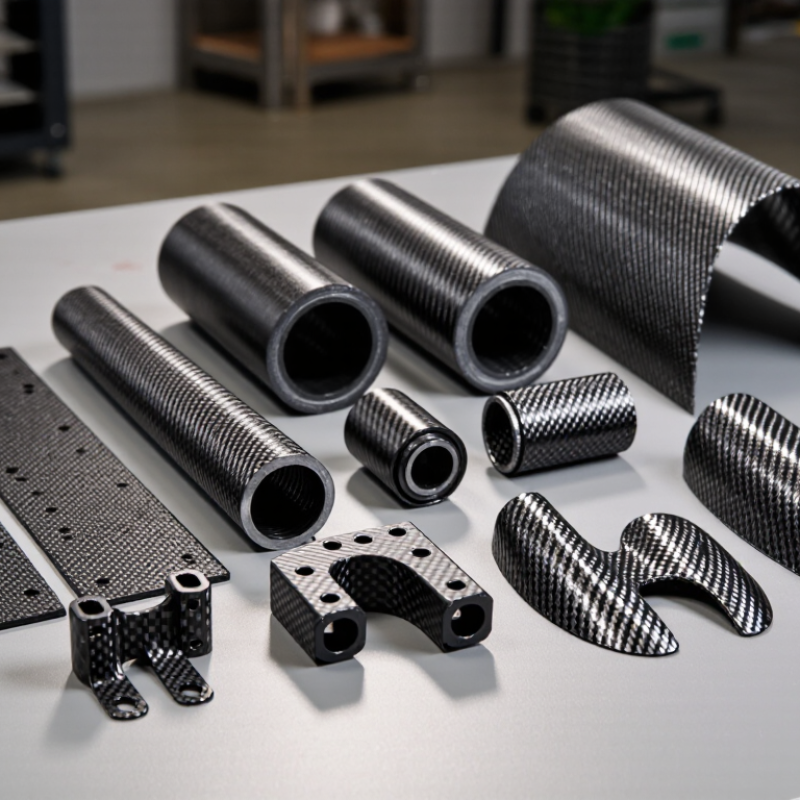
10 Best Carbon Fiber Components for Global Buyers?

Carbon Fiber Components: Definition, Properties, and Global Applications

Carbon fiber components are parts made from carbon-fiber-reinforced polymer, combining strong carbon filaments with a resin matrix. Common examples include panels, tubes, brackets, covers, shafts, frames, and protective housings. The fibers carry most of the load, while the resin holds their direction and shape.

They are valued for high stiffness, low weight, corrosion resistance, and controlled thermal expansion.

A carbon panel may feel remarkably light in the hand. Yet surface appearance proves little. Fiber orientation, laminate thickness, curing quality, and joint design determine real performance.

Carbon fiber is not magic.

Global applications

Global applications include aerospace interiors, medical equipment, renewable-energy structures, robotics, marine parts, and performance vehicles. In each field, engineers match the component to vibration, temperature, moisture, and impact conditions.

A lightweight tube may work well under axial force but fail near a poorly designed drilled hole.

Experienced buyers should request drawings, material specifications, production tolerances, and inspection records.

Useful evidence includes fiber type, resin system, test methods, and batch traceability. Independent testing can verify tensile strength, stiffness, fatigue behavior, and dimensional accuracy.

Supply chains still create uncertainty. Shipping damage, inconsistent finishing, or unclear customs descriptions can delay projects. That risk deserves attention.

Careful sampling, clear acceptance criteria, and communication with technical suppliers make purchasing decisions more reliable.

How to Evaluate Carbon Fiber Components for International Purchasing

Global buyers should evaluate carbon fiber components by performance, evidence, and supply reliability.

Tubes, plates, brackets, shafts, panels, and molded housings may look similar, but their fiber direction and resin systems differ. Ask for tensile strength, tensile modulus, interlaminar shear strength, void content, and dimensional tolerances. A glossy surface proves little.

Demand is expanding.

The International Energy Agency reported nearly 14 million electric car sales in 2023, a 35% annual increase. The Global Wind Energy Council recorded 117 GW of new wind capacity that year.

These figures support wider composite demand, but they do not guarantee consistent component quality. Request lot-specific test reports, cure records, material certificates, and samples from the same production process. ISO 9001 certification helps, yet it cannot replace independent inspection.

International purchasing adds practical risks.

Confirm the HS classification, packing method, moisture protection, delivery terms, and replacement procedure before payment. Carbon parts can arrive with crushed edges, warped plates, or hidden delamination after poor sea transport.

A supplier should explain allowable defects in writing. Check whether the design uses standard carbon grades or a proprietary layup. Standard materials usually simplify future sourcing. Not always.

A spreadsheet can hide real weaknesses.

Compare stiffness per kilogram, not only unit price. Review fatigue data when vibration, cycling, or temperature changes matter. MarketsandMarkets’ 2024 carbon fiber report projects double-digit market growth through 2029, increasing supplier variety and making verification more important.

A low quotation may reflect thinner laminate, weaker inspection, or incomplete documentation. That needs questioning.

The 10 Best Carbon Fiber Components by Function and Performance

Carbon fiber components should be selected by function, not appearance. The 2024 MarketsandMarkets Carbon Fiber Market report forecasts growth from about USD 4.7 billion in 2023 to USD 7.1 billion by 2028. That growth reflects demand for lighter, stronger engineered parts.

The ten strongest options cover distinct needs. Carbon fiber tubes suit frames and robotic arms. Plates provide rigid mounting surfaces. Rods support light structural loads. Panels reduce vehicle body weight. Brackets improve stiffness around joints. Shafts transfer rotation with low mass. Springs store energy while resisting fatigue. Pressure vessels handle demanding containment applications. Leaf springs reduce suspension weight. Protective enclosures combine stiffness with electrical insulation. Carbon fiber itself offers high specific strength, but resin quality and fiber direction control real performance. The 2024 ASM Handbook notes typical carbon fiber densities near 1.5–2.0 g/cm³, far below many metals. Actual component strength can still disappoint. Poor bonding remains a common weakness.

Tips: Ask for fiber orientation, resin type, void content, test temperature, and fatigue results. Request batch-level inspection records. Compare stiffness-to-weight, not tensile strength alone. For global sourcing, confirm dimensional tolerances and recognized testing methods. My practical concern is often overlooked: a lighter component may need thicker edges, stronger inserts, or better impact protection. Performance claims without loading data deserve caution.

10 Best Carbon Fiber Components for Global Buyers? - The 10 Best Carbon Fiber Components by Function and Performance

Typical industry values for carbon fiber reinforced polymer (CFRP) components. Actual performance depends on fiber grade, laminate design, resin system, manufacturing process, safety factors, and applicable standards.
Rank Carbon Fiber Component Primary Function Typical Construction Key Performance Data Typical Weight or Mass Benefit Common Manufacturing Process Best-Buying Considerations
1 Aerospace Structural Panel Low-mass aircraft floors, fairings, access panels, and secondary structures Carbon fabric or unidirectional tape with an epoxy or high-temperature thermoset matrix; honeycomb or foam core for sandwich panels Specific tensile strength commonly 500–1,500 kN·m/kg; laminate tensile modulus commonly 50–150 GPa; low thermal expansion Often 20–40% lighter than comparable aluminum panels, depending on design and certification requirements Prepreg lay-up, autoclave curing, out-of-autoclave curing, or resin transfer molding Verify aerospace qualification, flame-smoke-toxicity performance, impact tolerance, traceability, and non-destructive inspection capability
2 Automotive Body Panel Exterior body panels, roofs, hoods, deck lids, and aerodynamic structures Glass-carbon hybrid or all-carbon laminate with painted, gel-coated, or clear-coated surface High stiffness-to-weight ratio; typical laminate modulus 40–120 GPa; good fatigue resistance when properly designed Commonly 30–60% lighter than equivalent steel panels; savings vary with hinges, latches, and reinforcement design Compression molding, resin transfer molding, prepreg molding, or vacuum infusion Check dimensional tolerances, surface quality, UV stability, repairability, crash behavior, and compatibility with metal fasteners
3 High-Pressure Hydrogen or Gas Vessel Storage of compressed hydrogen, natural gas, or industrial gases Polymer liner or metal liner fully overwrapped with hoop and helical carbon fiber layers Working pressures commonly 350 or 700 bar for hydrogen systems; high burst-to-working-pressure safety margins are required Typically 50–70% lighter than all-metal vessels at comparable usable capacity Filament winding with controlled fiber tension and resin curing Require certification to the relevant pressure-vessel standard, permeation testing, cycle testing, impact resistance, and valve-interface validation
4 Wind Turbine Spar Cap Carries bending loads along the main load-bearing region of a wind turbine blade Thick unidirectional carbon fiber laminate integrated into a fiberglass or hybrid composite blade shell High longitudinal stiffness; carbon laminate tensile modulus commonly 100–180 GPa; designed for millions of fatigue cycles Can reduce spar mass and blade deflection compared with all-glass designs, particularly for long blades Pultrusion, automated fiber placement, resin infusion, or bonded subcomponent assembly Evaluate fatigue data, resin toughness, lightning protection, bond-line quality, transport dimensions, and end-of-life strategy
5 Composite Drive Shaft Transfers torque while reducing rotating mass and vibration Tubular carbon fiber laminate with metal end fittings, bonded or mechanically retained High torsional stiffness; operating speed may exceed 8,000 rpm in specialized designs; low critical-speed sensitivity when correctly balanced Often 30–60% lighter than steel shafts; reduced polar mass can improve drivetrain response Filament winding, roll wrapping, compression molding, and precision bonding Check torque rating, burst speed, torsional fatigue, balance grade, temperature near exhaust systems, and joint inspection procedures
6 Bicycle Frame and Fork Provides a stiff, lightweight structure for road, gravel, mountain, and track bicycles Directional carbon prepreg or wet laminate with locally reinforced joints and load paths Frame stiffness is tuned by fiber orientation; carbon fiber tensile modulus commonly ranges from 70–240 GPa by grade Complete frame sets commonly weigh about 0.8–1.5 kg, excluding components, depending on use and safety requirements Bladder molding, compression molding, internal mandrel molding, and bonded tube construction Confirm applicable bicycle safety testing, impact resistance, alignment tolerance, insert design, warranty support, and repair policy
7 Prosthetic Running Blade Stores and releases elastic energy during running and sprinting Layered unidirectional carbon fiber laminate with a curved spring geometry and reinforced attachment zone High elastic energy return; designed for repeated flexural loading and controlled deflection rather than simple static strength Low distal mass helps reduce swing effort; product mass commonly ranges from approximately 0.5–1.5 kg depending on size and design Compression molding, press molding, and precision laminate curing Match stiffness category to user mass and activity, and verify alignment, fatigue life, socket compatibility, and clinical fitting support
8 Robotic Arm Link Reduces moving mass and improves positioning efficiency in industrial or collaborative robots Carbon fiber tube or monocoque shell with aluminum or steel bearing interfaces High bending stiffness-to-mass ratio; low inertia can improve acceleration, repeatability, and energy efficiency Typically 30–50% lighter than an equivalent metal link, depending on joint hardware and safety factor Filament winding, pultruded tube assembly, prepreg molding, or resin transfer molding Specify allowable deflection, joint stiffness, vibration behavior, cable routing, galvanic isolation, and dimensional repeatability
9 Marine Mast or Boom Supports sails, rigging, and aerodynamic loads on performance vessels Large tapered carbon laminate with unidirectional fibers aligned along primary bending and compression loads High bending stiffness and corrosion resistance; designed for cyclic wave and wind loading Commonly 25–50% lighter than aluminum spars of comparable stiffness Mandrel wrapping, filament winding, prepreg curing, or vacuum infusion Review buckling analysis, fatigue life, UV and moisture protection, deck-interface loads, lightning protection, and repair logistics
10 Motorsport Safety Seat Provides occupant support while minimizing mass inside a high-performance vehicle Carbon fiber shell with energy-absorbing foam, head restraints, mounting brackets, and compatible restraint openings High shell stiffness with controlled energy absorption from the complete seat system; impact performance depends on the full assembly Shell mass commonly about 3–8 kg, depending on size, padding, mounting hardware, and homologation level Prepreg molding, autoclave curing, compression molding, or resin transfer molding Require relevant motorsport or vehicle safety approval, correct harness geometry, fire performance, padding specification, and seat-mount validation

Manufacturing Methods, Quality Standards, and Certification Requirements

Carbon fiber components vary widely in performance, cost, and production risk. Global buyers should examine the manufacturing method before comparing prices. Prepreg and autoclave processing delivers excellent fiber alignment and low void content for demanding panels, brackets, and structural shells. However, it requires careful temperature and pressure control. Compression molding supports faster production of repeated parts. Resin transfer molding can produce complex housings with consistent surfaces. Filament winding remains effective for tubes, pressure vessels, and cylindrical structures.

Quality begins with controlled raw materials. Suppliers should provide fiber grade, resin data, batch numbers, and storage records. During production, inspectors should verify fiber orientation, resin ratio, cure temperature, surface defects, and final dimensions. Ultrasonic testing can reveal hidden delamination. A small measurement error can affect assembly. It happens.

Certification requirements depend on the component’s application and destination market. ISO 9001 demonstrates a controlled quality management system, but it does not automatically prove product performance. Buyers should request mechanical test reports, dimensional inspection records, and certificates of conformity. Relevant ASTM, ISO, or EN test methods should be clearly identified. Independent laboratory verification adds credibility, especially for safety-sensitive components. Traceability must connect the finished part to its material batch and inspection results.

In real sourcing projects, paperwork is often stronger than production discipline. That is a warning. Buyers should audit process controls, review sample parts, and confirm whether certificates match the exact component. A supplier may meet a standard while missing a practical requirement, such as tight hole tolerances or stable surface finish. Clear drawings and acceptance criteria prevent expensive misunderstandings.

10 Best Carbon Fiber Components for Global Buyers

The chart compares indicative fiber-volume fractions commonly used in structural carbon-fiber components. Higher fiber volume generally improves stiffness and strength, but the final performance also depends on fiber architecture, resin system, void content, laminate design, and process control.

Component Typical Manufacturing Method Common Quality / Certification Requirements
Automotive body panelCompression molding or RTMISO 9001, dimensional inspection, void-content and laminate testing
Drive shaft tubeFilament windingISO 9001, torsional fatigue, balance, concentricity and non-destructive testing
Composite pressure vesselFilament windingISO 11119 or applicable pressure-vessel regulations, burst and cyclic-pressure testing
Bicycle framePrepreg compression moldingISO 4210, fatigue testing, impact testing and dimensional verification
Aircraft interior panelPrepreg autoclave or out-of-autoclave moldingAS9100, FAR/CS 25.853 flammability requirements and traceability
Wind-turbine spar capPultrusion or resin infusionISO 9001, IEC 61400-related design verification and fatigue testing
Robotic arm linkRTM or prepreg moldingISO 9001, stiffness, fatigue, dimensional and load testing
Prosthetic socketWet lay-up or vacuum infusionISO 10328 for prosthetic structural testing and biocompatibility where applicable
Marine mastFilament winding or vacuum infusionISO 12215 structural design principles and fatigue / weathering evaluation
Industrial pulleyCompression molding or RTMISO 9001, wear, dimensional, load and rotational-balance testing

Pricing, Customization, Shipping, and Supplier Selection Worldwide

For global buyers, ten practical carbon fiber components include tubes, panels, brackets, housings, shafts, frames, fairings, covers, mounts, and protective guards. Each suits a different load path. Tubes and panels often offer strong weight savings, while brackets require precise inserts and controlled resin flow. The 2024 Fortune Business Insights report valued the global carbon fiber market at about USD 3.91 billion in 2023, showing strong demand for engineered parts.

PRICING & CUSTOMIZATION
Pricing depends on fiber grade, mold design, volume, machining, and inspection. A prototype may cost more than a small production batch because tooling dominates early orders. Customization needs clear drawings, tolerance limits, surface requirements, and testing standards. Ask suppliers for fiber orientation records, cure data, dimensional reports, and sample approval. Cheap quotes can hide weak inspection.

SHIPPING & LOGISTICS
Shipping needs equal attention. Large frames may require custom crates, moisture protection, and dimensional checks before loading. Incoterms, insurance, customs documents, and tariff classification should appear in the quotation. The International Air Transport Association reported global air cargo demand growth in 2023, but air freight still creates severe cost swings. Sea freight reduces cost but extends lead times. Confirm packaging photos and tracking procedures.

A supplier should show stable capacity, engineering support, and traceable materials. Visit remotely if necessary. Request two comparable quotations. Do not trust polished certificates alone; verify their scope and validity. I have seen buyers specify strength but forget repair access and replacement quantities. That mistake becomes expensive. Supplier selection is never only about price.

Translate »